
We have been rewriting this document for months. It is now at a version we are willing to put our name on, which is why it is numbered version 1 and why every draft that went around privately before this is retired. If a figure you saw somewhere does not match this paper, this paper is the one that counts.
Read it at forked.gg/whitepaper. There is a PDF if you want to keep it and a browser version if you just want to scroll. If you only have ten minutes, the executive summary is on page 2, the node network is section 6, and the token model is section 13. Those three carry most of the design.
The money, on one page
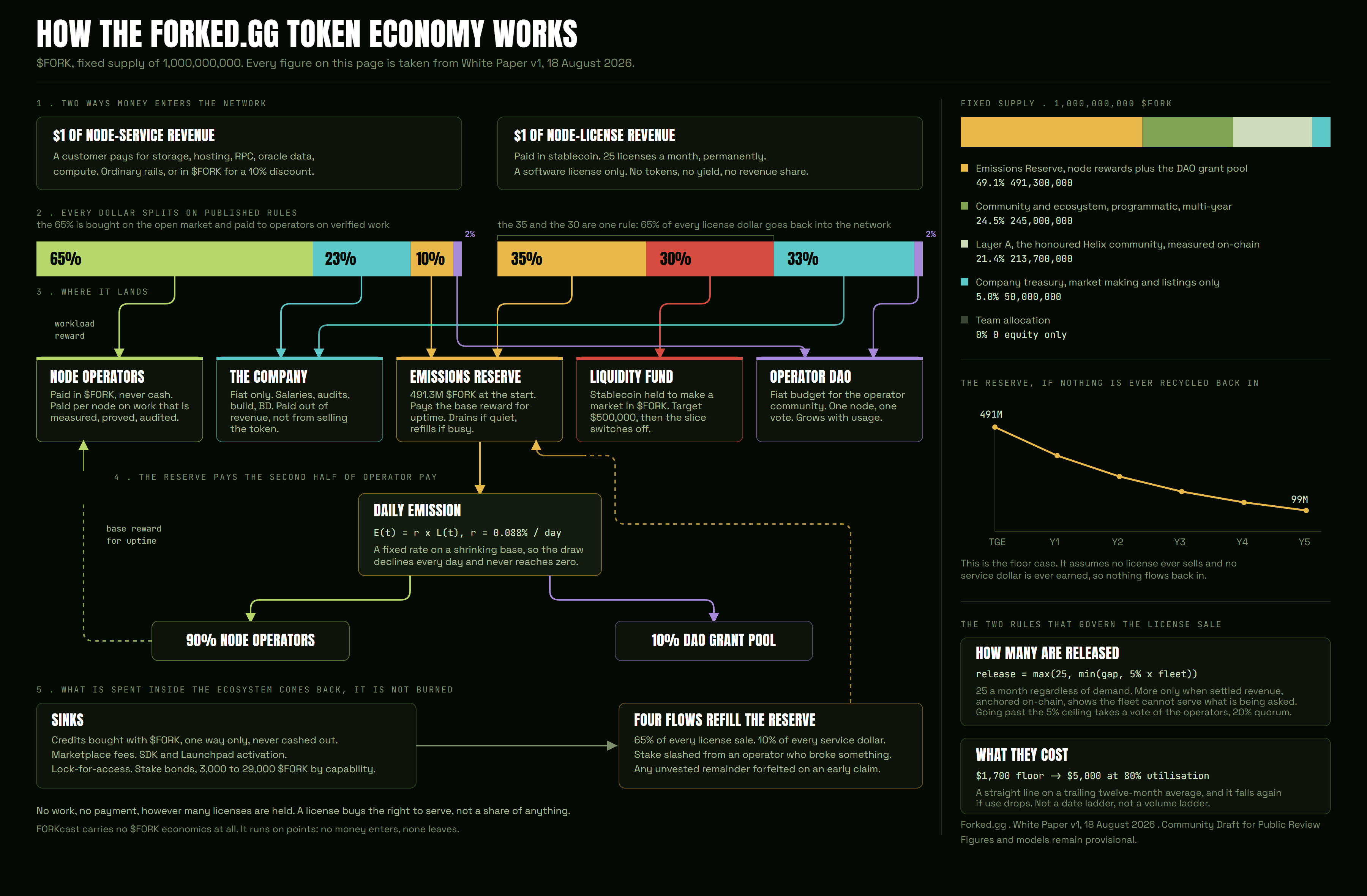
Section 13 runs sixteen pages, which is a lot to ask of anyone who just wants to know whether the numbers add up. So here is every flow in the economy in a single diagram. Each figure on it comes straight out of the paper.
Reading the map
Money enters the network two ways and only two ways. A customer pays for storage, hosting, RPC, oracle data or compute, on ordinary payment rails or in $FORK for a ten percent discount. Or somebody buys a node license, in stablecoin, twenty-five of them a month, permanently. A license is software and nothing else. It carries no tokens, no yield and no share of revenue.
Every dollar that comes in splits on rules that are published rather than decided later. A service dollar goes sixty-five percent to the operators who did the work, twenty-three to the company, ten into the emissions reserve and two to the operator DAO. A license dollar goes thirty-five to the reserve and thirty to the liquidity fund, which is one rule wearing two labels, because both halves put that sixty-five percent back into the network. The remaining thirty-three is company revenue and two goes to the DAO.
Operators are paid in $FORK, never in cash, and paid per node for work that is measured, proved and audited. The company is paid in fiat only, out of revenue, salaries and audits and build and business development. That distinction is the whole point of the design. The company makes money when the product makes money, and it has no token to sell to cover a bad quarter.
The reserve, and why it shrinks
Uptime pay comes out of the emissions reserve, which starts at 491,300,000 $FORK. The daily draw is a fixed rate of 0.088 percent applied to whatever is left, so the amount emitted declines every single day and never reaches zero. Ninety percent of that goes to node operators and ten percent to the DAO grant pool.
The chart on the right of the diagram is the floor case. It assumes no license ever sells and no service dollar is ever earned, so nothing flows back in, and on those assumptions the reserve falls from 491 million to 99 million by year five. We published the pessimistic version on purpose. Four flows refill it in practice: sixty-five percent of every license sale, ten percent of every service dollar, stake slashed from an operator who broke something, and any unvested remainder forfeited on an early claim.
What gets spent inside the ecosystem comes back rather than being burned. Credits bought with $FORK move one way and are never cashed out. Marketplace fees, SDK and Launchpad activation, and lock-for-access bonds between 3,000 and 29,000 $FORK depending on capability all land back in the system.
Three numbers that define the design
That last one is worth explaining, because leaving it out looks like an omission until you think about what putting it in would mean. A projected token price is the easiest thing in the world to write down and the hardest to stand behind. Every figure in the paper is stated in the unit it is actually denominated in, and the document converts between them nowhere.
One more thing the diagram makes plain. FORKcast carries no $FORK economics whatsoever. It runs on points, no money enters and none leaves, and that is a wall in the ledger rather than a setting somebody can flip.
What is not finished
The paper says this itself and we would rather repeat it here than have you find it on page 53. The corporate entity is not formed and is with counsel. No independent audit has been completed, and no mainnet contract goes live without one. Contract addresses are still to be announced, and the contracts that exist today run on BNB Chain testnet. The license classification question is open with counsel. Node reward and SAFT figures stay provisional until the event.
None of that is buried. A paper that survives being read by somebody hostile is one that lists its own open problems, and there is a plain summary of all of them on the white paper page so nobody has to go looking.
Tell us what we got wrong
Version 1 is marked a community draft for public review, which is a longer way of saying we want holes found in it. If something is wrong, unclear, or sounds too good to be true, bring it to the Discord and we will answer it in the open. If you are right it goes into the next version, and the correction is visible rather than quietly patched.