
The team behind Forked.gg holds zero $FORK. Not a small allocation, not a vesting schedule that quietly opens in eighteen months, not a founder wallet parked behind a multisig. Zero. There is no path anywhere in this design that hands anyone on the team a token they could sell, which means the only way we make money is the boring way, by running a company that customers pay for something they actually want.
That sentence is easy to write and most of the industry has written some version of it. What follows is the arithmetic underneath it, because the arithmetic is the only part you should care about.
The pattern everybody has watched by now
You already know how this normally goes, so let us say it plainly instead of dancing around it.
A project launches with a team allocation. Fifteen percent, twenty, sometimes more once you count the advisor grants and the “ecosystem fund” that nobody can quite explain. The team has no revenue, because the product is a year away and the customers do not exist yet. Payroll still arrives every two weeks. Servers still cost money. The audit still costs money.
So the team sells. It has to. There is nothing else to sell.
At that point the team and everyone holding the token are pointed in opposite directions, permanently, by the structure itself rather than by anyone's bad intent. Every good week on the chart becomes an opportunity for the treasury to fund another quarter. Every one of those sales lands on the people who bought in because they believed the thing would work. Founders who genuinely meant well end up as the largest and most reliable seller in their own market, and they stay that way until the allocation runs out or the project does.
The market has now watched that movie enough times to recognize it from the first frame. People are not being cynical when they check a token distribution before they read the pitch. They are doing the sensible thing.
What we took out
We built Forked.gg with the team allocation removed entirely, and then built the rest of the model around that absence.
The supply is one billion $FORK, fixed, and it splits like this. The honored early operator community takes ~21.4%, sized by real on-chain balances rather than chosen by us. Community and ecosystem gets ~24.5%. The company treasury is fixed at 5%, to be used exclusively for market making, liquidity and exchange listings. Everything left over lands in the Emissions Reserve, which is the pool node operators are actually paid from. The team line reads zero.
One line inside that distribution does need naming, because skipping past it would be the kind of omission this whole post is arguing against. Six advisors hold 0.1% of supply each, which is 0.6% of the cap between them, about 6 million $FORK. Those are standing contractual obligations rather than something we chose while writing this, they vest monthly across thirty-six months with no cliff, and they sit inside the honored operator layer rather than on top of it. The figure is published on our transparency page. Nobody on the Forked.gg team is in that line, and the two advisors closest to the project day to day, Jason Brink and Patrick Bergman, hold no allocation of any kind.
Emission itself splits 90% to node operators and 10% to the DAO grant pool that operators govern. The company draws nothing from it. If you have run nodes for one of the projects that takes half of what the network emits before an operator sees a token, you already know why that number matters. There is no 50% cut here, no management fee, not a slice off the top, nothing. Every token that leaves the reserve goes to somebody who ran a machine and proved they did the work, or into a grant pool the operators themselves vote on. That governance is Aegis, it is one node one vote and never weighted by token balance, Forked.gg and its executives are subject to the same rules as everybody else, and a full cycle of register, propose, vote, execute and pay has already run on-chain on testnet. It stays dormant until 250 operational nodes switch it on, and we built no mechanism that lets us start that clock early. No governance theater here.
We also do not run a fleet of company nodes quietly earning out of that pool. There is no house account sitting inside the reward system taking a cut of what operators are competing for. The boxes we do run are development and demo infrastructure, and they are not registered earners collecting emissions. If we ever changed that we would be competing against our own operators for the pool we are supposed to be filling, and the whole argument in this post would stop being true. That is a hard line in the sand for us.
So how does the company eat
Two ways, both of them ordinary business revenue, both of them paid in dollars rather than tokens.
Node licenses are priced in dollars and paid in stablecoins. Of every license sale, 65% goes back into the network, 2% goes to the operator-controlled DAO, and the remaining 33% is company revenue that builds node services and platform functionality. The price starts at a $1,700 floor and rises only as the network proves it is being used, reaching a $5,000 ceiling at 80% utilisation, tied to a measure that lives on-chain rather than in a spreadsheet we control. The 3,278 licenses already issued to early operators carry across one for one and cost their holders nothing.
Service revenue is the second one, and over time it is the real one. Customers pay ordinary money for storage, delivery, live game hosting, RPC and oracle data, inference and GPU compute. Every service payment splits four ways: 65% buys $FORK on the open market and routes it to the operators who did the work, 23% stays with the company in fiat to run operations, 10% is bought back into the Emissions Reserve, and 2% goes to the operator DAO in fiat.
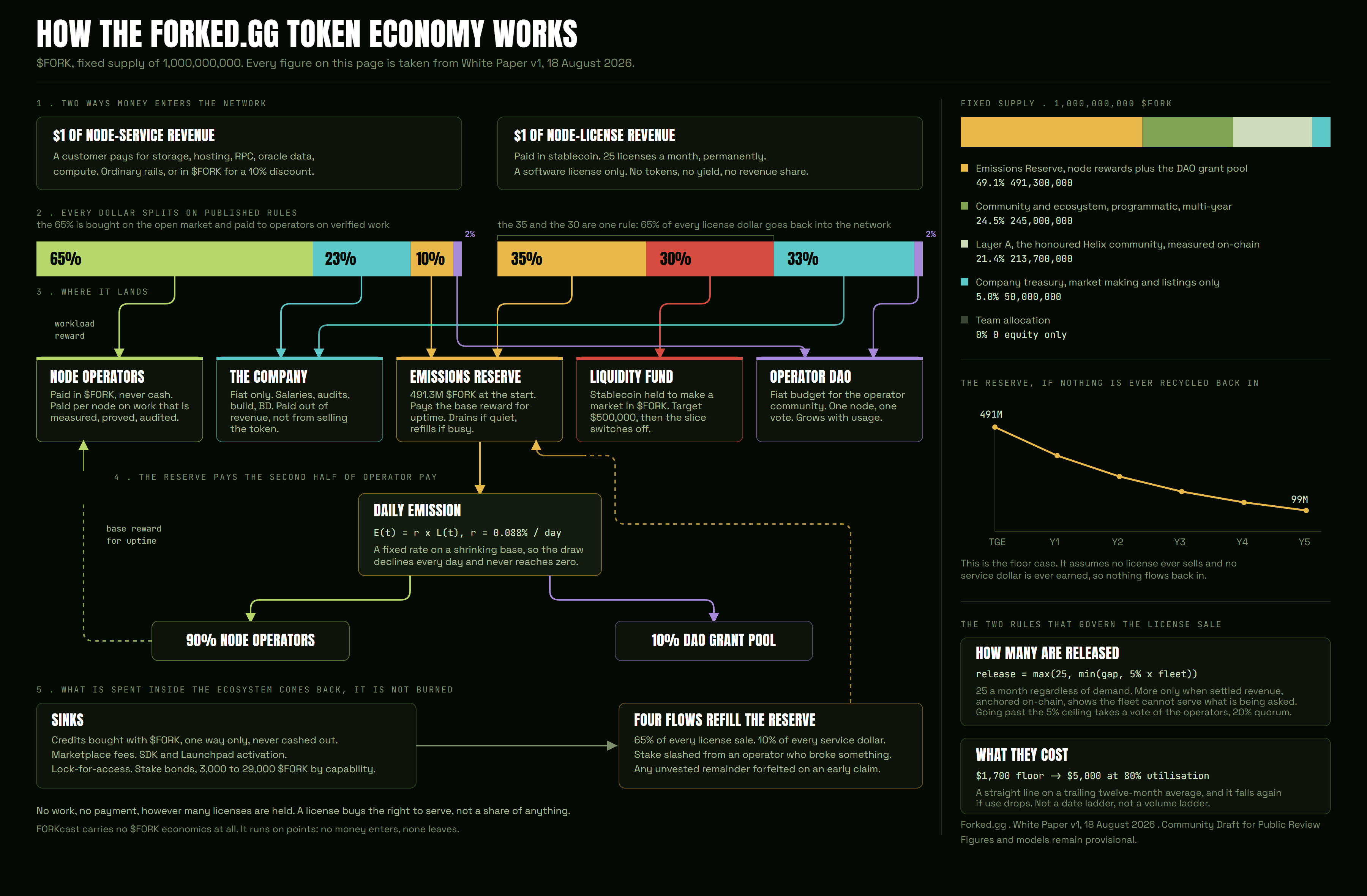
Read those two splits together and you can see the shape of the thing. Operators get compensated entirely in $FORK for verified work and never receive cash from us, while the company only ever takes its cut in fiat. Salaries, audits, counsel and business development all come out of that 23% share of service revenue and the 33% share of license sales. None of it comes out of selling $FORK, because we do not hold $FORK to sell.
The direction of that flow matters more than any promise we could attach to it. Money coming into the network turns into buying pressure on the token mechanically, because 75 cents of every service dollar is spent buying $FORK on the open market, 65 passed through to operators and 10 bought back into the reserve. On the fleet modelled in the white paper that is roughly $9.4M of committed buying over five years, and more if licenses sell. We are not standing on the other side of that trade.
One more piece of honesty while we are here. The team owns the operating company through equity, so there is an indirect line from the value of that treasury back to us. The 5% exists to make a market, provide liquidity and pay for exchange listings, and a market-making position trades in both directions by design, so we are not going to pretend that nothing ever leaves that wallet. What will never happen is a token out of it paying a salary, a bonus or an invoice, and there is no second pile sitting behind it with our names on it. The wallet is multi-signature, no one person can move it alone, the address goes public at TGE, and every move it makes is visible on-chain for you to check against this paragraph.
What this costs us
Removing the team allocation is not a free virtue signal. It takes away the safety net that most projects in this space quietly rely on.
There is no reserve for us to lean on in a slow quarter. If service revenue is thin then the company is thin, and the only fix available to us is selling more of the product or getting more work onto the network. Nobody on the team is drawing a salary right now. The operating cost is servers, and that cost falls as node operators take the work over. We are not offering that as a hardship story. It is the thing that lets us wait rather than push licenses into a market that does not need them yet, which is why only 25 are put on the shelf in a month and why the token math in the white paper assumes none of them sell at all.
It also means we carry real risk, and we would rather be straight about that than dress it up. A model with no team supply behind it only pays the people who built it if the product genuinely works, so our outcome is settled at the same time as everyone else's rather than a couple of years earlier. Building without a reserve to fall back on is harder, and it removes the exit hatch that we would probably be tempted to use eventually if we left one in.
Go check it
None of this is meant to be taken on faith. The full allocation table, the revenue splits, the license release rule and the reserve math are all in the white paper, including the parts where the numbers are uncomfortable and we say so anyway. The treasury address will be public at TGE. The emission curve is public. The metering that decides who earned what is running in production today against real nodes.
Compare what you just read against those documents. If a number here does not match a number there, tell us, and we will fix whichever one is wrong, in public.
What we are asking for is to be judged on the structure rather than on how sincere we sound while describing it. Plenty of teams have promised they would not dump, and most of them meant it at the time they said it, right up until the quarter where payroll and the chart collided and the allocation was sitting right there. We removed the allocation so that promise never has to get tested on us. You do not have to take our word for that part, which is the entire reason we built it this way.
We strongly believe that projects that dump on their own communities should Get Forked.