
The movement, one more time
The loudest thing in gaming right now is still a simple ask. Players want to own what they buy, and they want the games they love to keep living instead of getting switched off the day they stop turning a profit. Studios cannot carry forever-hosting on their own, because the money runs out long before the players do. A lot of what web3 promised gaming over the years showed up as a token first and a real product never. We think that is backwards. The genuinely useful part, under all the noise, is plain: a way to pay a big spread-out crowd to keep something running and to prove they are really doing it, without one company carrying the whole cost. That crowd is the whole point of Forked.gg, and this week we put a fun, concrete face on it.
The network carried a whole movie
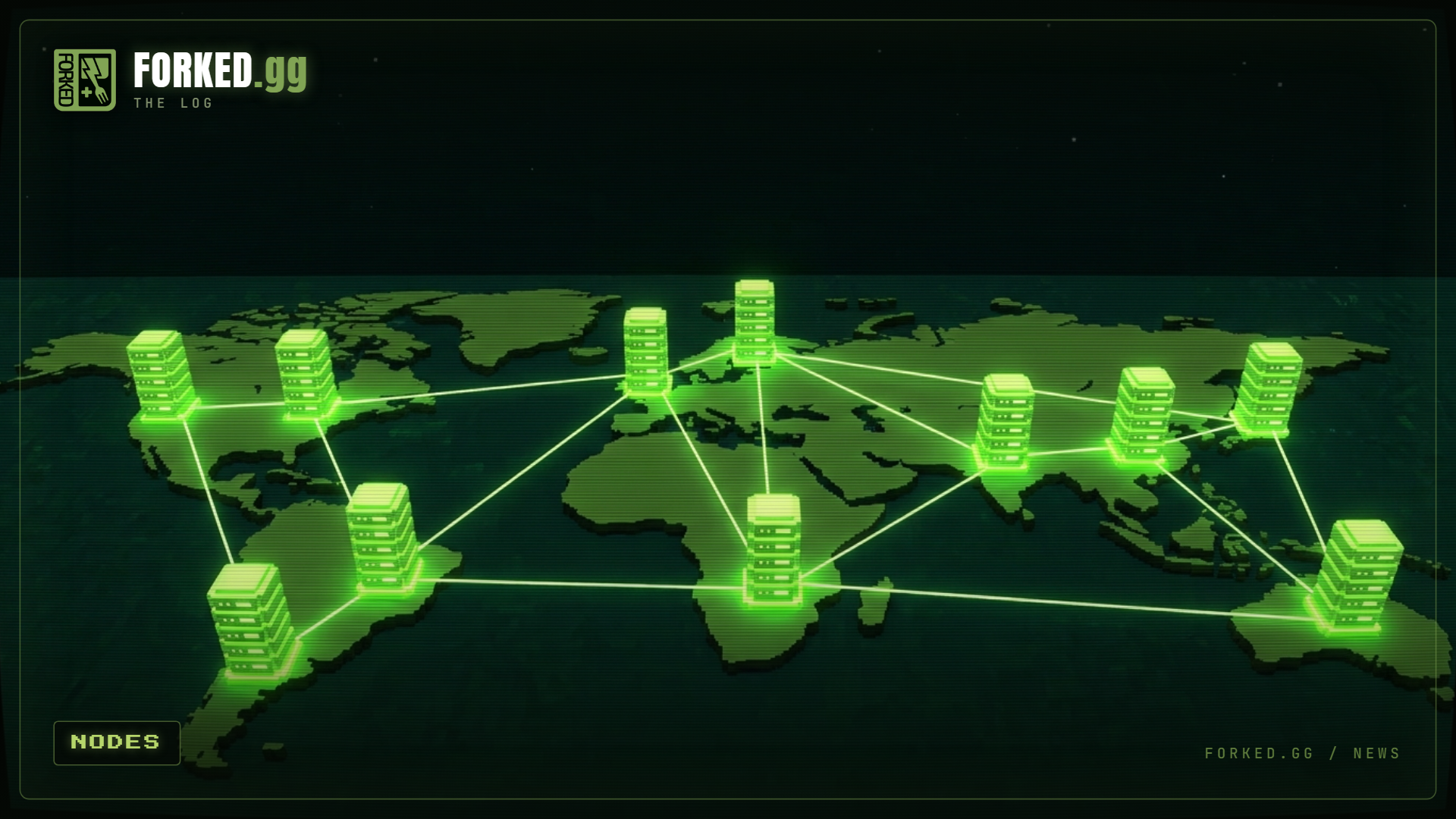
We ran a feature-length film through the network end to end, the whole thing, about an hour and a half of it. The part that makes it interesting is where the movie lived. It was not sitting on one server in one building. It was spread across a network of machines in a dozen different cities, and when you hit play, the network pulled it back together in real time and handed you every single frame, perfect, in order, exactly as it started.
The film, since you are going to ask, was Night of the Living Dead, the old public-domain zombie classic. We picked it on purpose. A lot of node networks out there are, let us be honest, zombies. They sit there collecting rewards for doing nothing. Ours just reassembled a whole movie for you from all over the planet. That gap is the entire thing we care about.
What the network actually is
Worth slowing down on this, because the network is the thing everything else stands on. It is not a metaphor and it is not one big computer in a warehouse. It is a bunch of real, independent machines sitting in real cities on six continents, run by different people. When you hand it something to keep, it does not park a copy on one box and hope. It encrypts the data, breaks it into pieces, and scatters those pieces across many machines at once, so no single one holds the whole thing and no single one going dark can lose it. Then it keeps checking, over and over, that the pieces are still there and still exactly right, and it quietly rebuilds anything a dead machine took with it. Knock a few offline on purpose, which we do, and the data still comes back byte-for-byte identical.
Then we pushed it to a hundred machines
A network is only as good as it is under load, so we ran the test. We started with a small fleet of ten machines, then stood up a fresh one of a hundred machines spread across six continents and had every one of them encrypt, split, and spread its own data across the others, all at the same instant. Two things stood out, and both matter for keeping games alive.
First, it was flawless. Every file came back perfect at every size we threw at it, one hundred percent byte-for-byte identical, with a hundred machines all coordinating at once and no central server anywhere in the picture. Second, and this is the fun part, the network got faster as it got bigger. Ten machines moved data at a crawl because every one of them was tripping over the others. At a hundred, the work spread out thin, the pile-ups vanished, and the whole thing sped up. Roughly ten times the machines gave us about eighty times the throughput, and the line had not even leveled off.
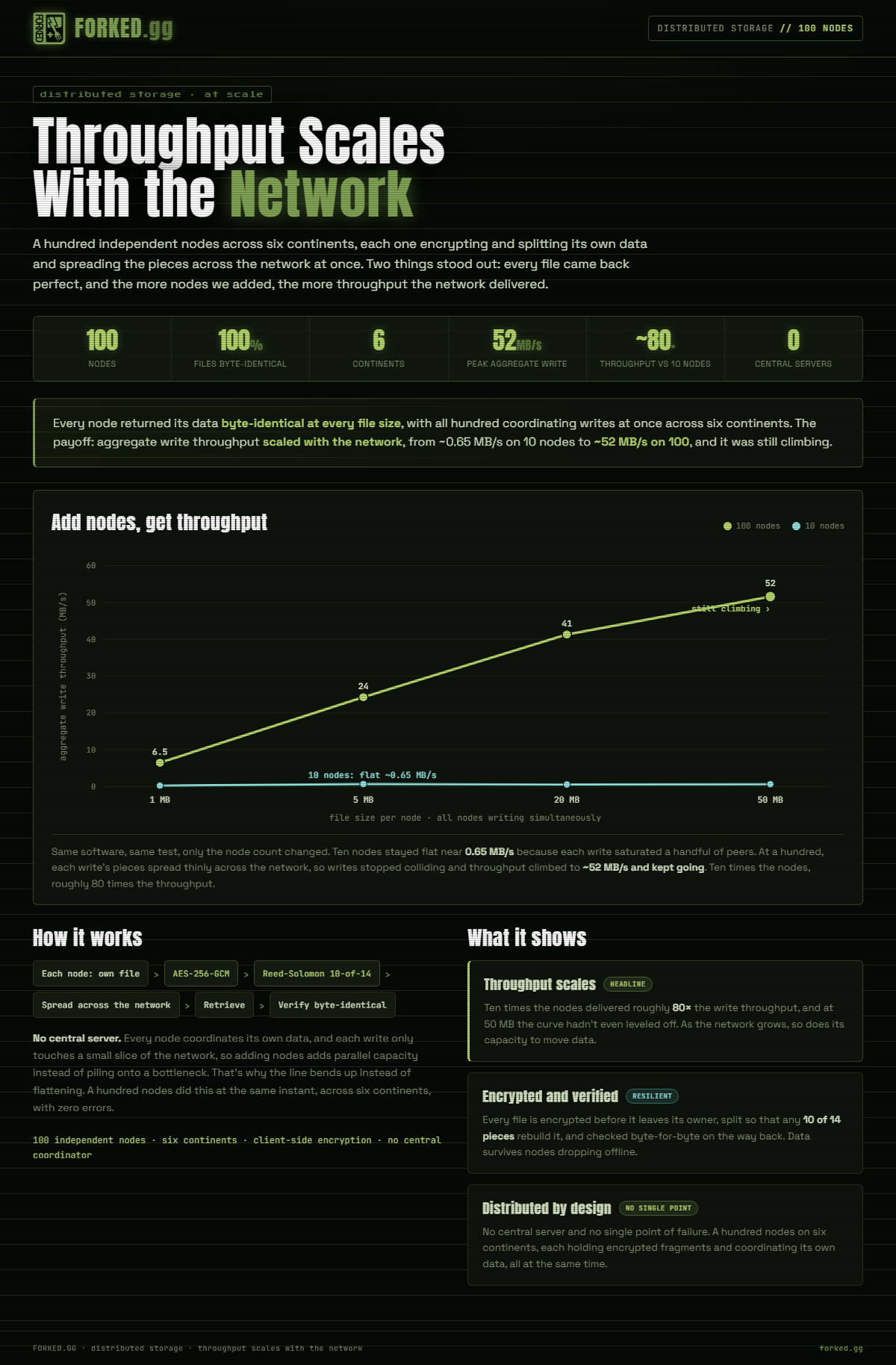
A game staying online forever is, underneath, a storage-and-delivery problem. Prove a worldwide crowd of machines can hold something big, hand it back flawlessly, and only get stronger as more join, and you have proven the hard part of keeping a game alive. That is what the movie and the hundred-machine test were really about.
More games you can just play
Minetest had company this week. Factorio, the much-loved build-a-sprawling-factory game, is now something you can spin up and play on Forked. Start a world and it stays online for people to join. No hunting for a host, no babysitting a machine in your closet, no "the server is down again" in the group chat. Instead of renting a server by the month and paying whether you touch it or not, the idea is you bring a world up when you want to play and let it rest when you are done. You want to play, the world is up.
A real home base for players
Here is something we have been building that gaming honestly does not have yet. There is no good place for players to just hang out, find their next game, and talk about it. You have a hundred scattered Discords, a store that is great at selling and bad at community, and forums nobody enjoys. So we are building the home base: a place to discover games, back the ones you love, and talk with people who love them too, all web2-first, none of the scary crypto stuff in your face. This week we stood up the first working version. It is early, and it is going to grow into the front door for everything else here, the discovery, the community, and, when you want it, spinning up a world to play in.
One account that is really you
For all of that to feel like one place instead of five, you need one identity that carries across it, so this week we tied the pieces together. Log in with Discord, one tap, no new password to forget, and your real Discord name and picture come with you instead of some random auto-generated handle and a stand-in avatar. That single account is the same you whether you are browsing games, backing one, or firing up a world to host. It is the spine that turns a pile of separate tools into a place that feels like yours from the first second.
Showing up pays
If you boost the Forked Discord server, that now banks you points every day you keep it up, the same way wearing the Forked tag does. Stack the two and it adds up faster. Those points live on your account and follow you across the ecosystem, so the time you put into the community turns into a real head start. The theme here has not moved since day one: your time and your support should count for something.
Something for your pocket
We have also been quietly building a Forked app for Android so you can carry your own media library around and play it anywhere, in the background, on the lock screen, the way a real player should work. It is early and still in testing with a small group, but it runs on a real phone and it already feels good. More on that when it is ready for everyone.
Where this is heading
Every one of these is a cog in the same machine. A network strong enough to carry the things you love and only get stronger as it grows, games that stay switched on, a home base to find them, and one account that is really yours across all of it. Right now these are separate pieces with a shared coat of paint, and the work in front of us is wiring them into one thing under the hood. The whole point is a world where a game never has to go dark just because a spreadsheet says to shut it down, and we are getting closer to it every week.
More next Sunday.