
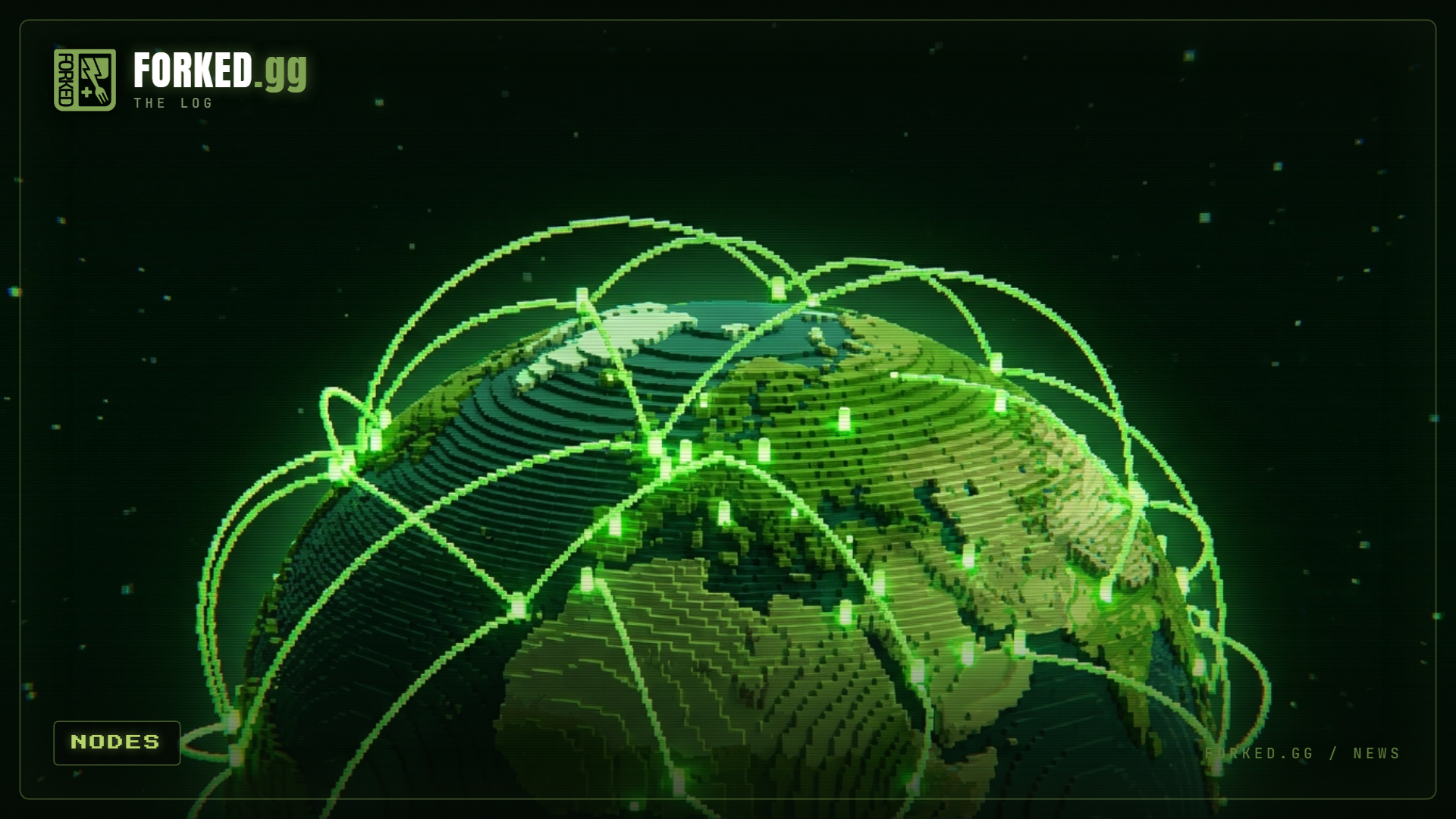
The long game for Forked is a community-owned network of machines that do real work and get paid for it. Storage is one of the first jobs on that network, and the hard part was never writing the code. It was proving the whole thing holds up over real distance, real latency, and real failure, on hardware we do not control. Over the last few days we did exactly that, in two steps.
Step one: a file across six continents
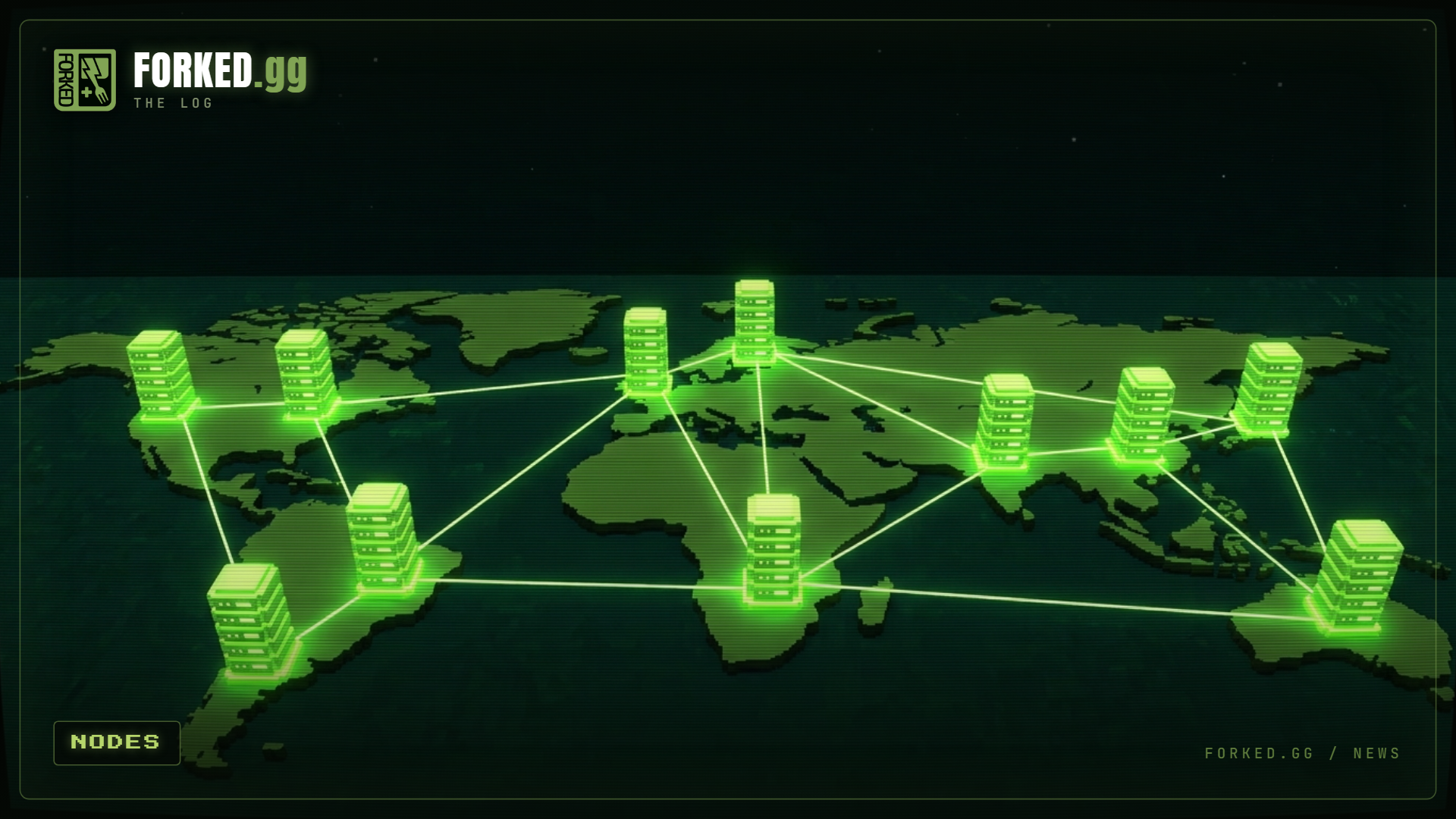
We stood up ten nodes in ten cities spread across six continents, from New York and Toronto to London, Amsterdam, Johannesburg, Bangalore, Singapore, Tokyo, Sydney, and Sao Paulo. Then we sent a real file into the network from a separate coordinator and watched what happened.
The file does not sit whole on any one machine. It is encrypted, then split into pieces with erasure coding, a technique that adds redundancy so the original can be rebuilt from a subset of the pieces. Those pieces scatter across the nodes. No single node holds enough to read your file, and no single node needs to survive for you to get it back.
Proving possession, then breaking it on purpose
Storing a piece is easy to claim and easy to fake. So the coordinator challenges each node to prove it still holds its exact piece, right now, without the node being able to guess the answer ahead of time. Every one passed. Full marks.
Then we did the part that actually matters. We killed nodes outright and asked for the file back. It came back whole and byte-for-byte identical to what we sent, rebuilt from the survivors. That is the promise of the whole design proven under real failure, not on a diagram.
Store across the fleet, verify possession on every node, retrieve byte-for-byte, then retrieve again after knocking nodes offline. Every stage passed over the open internet, with the encryption keys never leaving the client and never touching the network.
Step two: someone else's machines
A proof on hardware we spun up ourselves is a good start. The real test is whether other people can run the node software on their own machines and have it just work. This week a hosting partner answered that by standing up a full fleet.
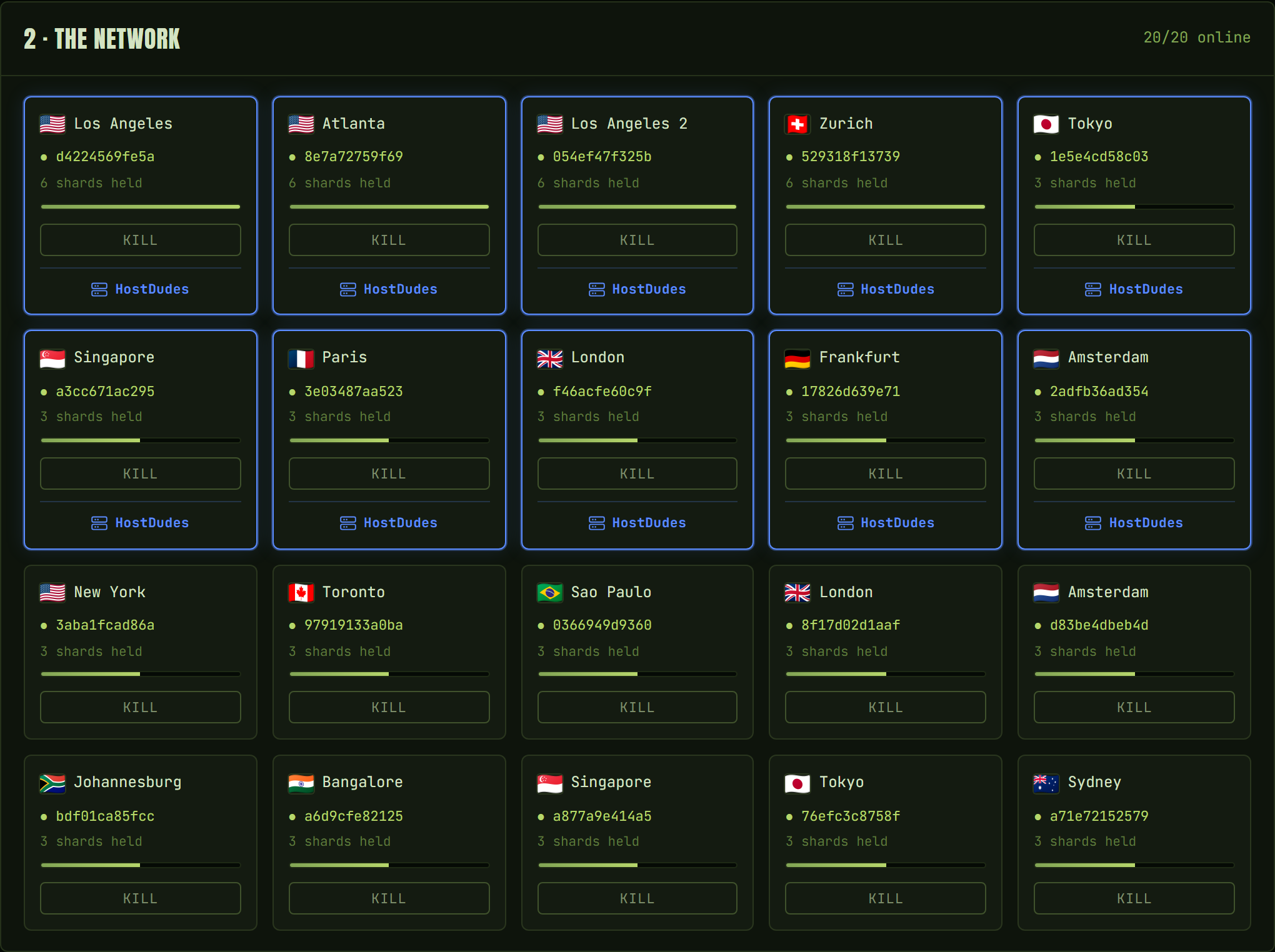
Ten machines came online across ten cities: two in Los Angeles, plus Atlanta, Zurich, Tokyo, Singapore, Paris, London, Frankfurt, and Amsterdam. These are the partner's own boxes, not ours, which is the entire point. The network is supposed to run on hardware we do not own and cannot see inside. We deployed the whole fleet with a single repeatable script, brought every box up, and confirmed each one was healthy end to end.
Those machines came from HostDudes, who host Forked.gg nodes so people who want to back the network do not have to rack and babysit hardware themselves. If you would rather someone else run the box while you own the node, they are a good place to start.
HostDudes The machines behind this fleet. HostDudes runs Forked.gg nodes for you, in data centers around the world. Visit HostDudesVerified, not just launched
Live is easy to claim. So we checked every node the hard way. Each one answers a fresh challenge with a valid cryptographic signature over the open internet, proving it is really the node it says it is and really doing the work. Every box came back clean. The shot below is the storage dashboard mid-run, with the HostDudes machines carrying their blue badge alongside the wider test fleet.
Where this goes
This was a proof run, not a consumer product launch. It tells us the storage layer works the way it has to before anyone trusts it with anything real, and that the network can live on machines outside our walls. Next we harden the persistence, wire the reward accounting that pays operators for the space they actually prove they are holding, and grow the fleet past its first ten cities. The network is starting to look like a network.